
Office owners planning renovations often discover that commercial interior painting cost estimates vary dramatically between contractors. This uncertainty makes budgeting challenging, especially when quotes range from reasonable to surprisingly expensive without clear explanations.
Raleigh’s commercial painting market follows specific pricing patterns based on measurable factors like square footage, wall condition, and material choices. Understanding these cost drivers helps you evaluate quotes accurately and budget appropriately for your office painting project.
This guide breaks down actual 2026 pricing data, explains how contractors calculate costs, and provides real examples from Raleigh office spaces to help you plan your investment.
How Commercial Interior Painting Costs Are Calculated
Contractors calculate commercial interior painting cost through a systematic process that combines square footage measurements, material requirements, and labor hours. Each component contributes to your final quote, and understanding these calculations reveals why prices vary between different office spaces.
Measuring Your Office Space
Square footage determines the foundation of any painting estimate. Contractors multiply wall length by height to calculate the surface area requiring paint. An office with walls measuring 20 feet tall and 30 feet long across four walls totals 2,400 square feet of surface area.
Windows and doors reduce the paintable area. Using the same example, four windows at 4 feet wide and 6 feet tall equal 96 square feet. Contractors subtract this from the total, bringing the actual painting area to 2,304 square feet. Ceiling calculations follow a different formula, using length multiplied by width rather than height.
This measurement accuracy prevents material waste and ensures labor estimates reflect the actual work required. Offices with numerous windows or glass partitions will see lower material costs than spaces with solid walls throughout.
Material Costs and Paint Requirements
Paint coverage follows a standard industry calculation. One gallon of paint typically covers 300 square feet on smooth surfaces. Premium-quality paint ranges between $40 and $60 per gallon. This translates to 13 to 20 cents per square foot for a single coat, or 26 to 40 cents per square foot when applying two coats.
A 2,400 square foot office requires approximately 16 gallons of paint for complete two-coat coverage, totaling $640 to $960 in material costs alone. Textured or porous surfaces absorb more paint, increasing both material quantities and associated costs.
Additional supplies factor into the final estimate. Brushes, rollers, trays, and masking materials add roughly $40 for a 400 square foot project, with larger spaces requiring proportionally more supplies.
Labor Rates in Raleigh
Professional painters in Raleigh charge between $55 and $65 per hour for commercial work. These rates reflect experienced crews with proper insurance, safety certifications, and proven expertise in commercial environments. A painter working at $65 per hour completes approximately 200 square feet per hour, which breaks down to 65 cents per square foot for labor.
An 800 square foot office takes four hours for the first coat and another four hours for the second coat, resulting in $520 in labor charges at the higher rate. Larger projects benefit from crew efficiency, though complex spaces with multiple rooms or obstacles may slow progress.
Prep work adds 2 to 3 hours to most projects. This includes scraping, cleaning, caulking, and priming surfaces before painting begins. Surface repairs beyond standard prep work incur additional labor charges, as damaged drywall or extensive patching falls outside typical preparation scope.
The Two-Coat Standard
Two coats of paint represent the industry standard for commercial spaces. The first coat provides base coverage, while the second ensures uniform color, proper adhesion, and long-lasting durability. Smooth, well-maintained walls in good condition typically require only these two applications.
Dramatic color changes demand additional coats. Covering dark walls with lighter shades often needs three coats or specialized primer to prevent the original color from showing through. This requirement doubles material costs and increases labor hours accordingly.
Combining these components, an 800 square foot office with standard conditions costs approximately $1.08 per square foot for professional two-coat application. This figure encompasses materials, labor, prep work, and supplies for walls in good condition requiring minimal repair.
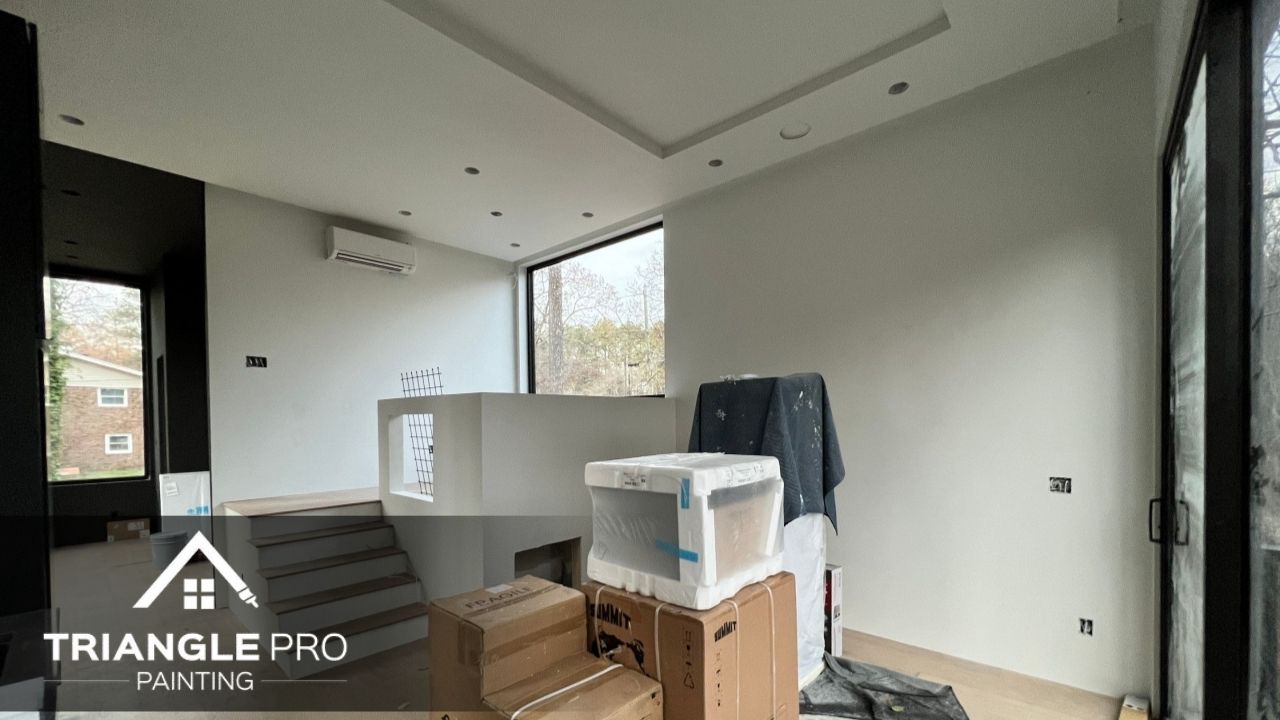
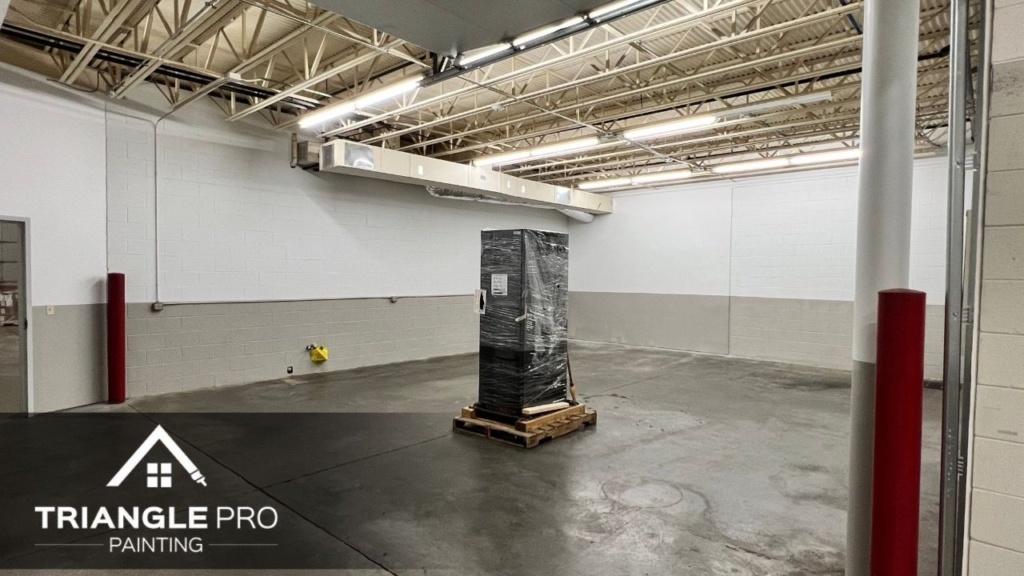
Average Interior Painting Cost Per Square Foot in Raleigh
Raleigh office spaces fall into three distinct pricing categories based on total square footage. Each size range comes with different cost considerations that affect your per-square-foot rate and total project investment.
Small Office Spaces (Under 1,000 sq ft)
Small office suites typically experience higher per-square-foot costs than larger spaces. An 800 square foot office costs approximately $1.08 per square foot for complete two-coat coverage, totaling around $864 in combined materials and labor. This rate reflects the minimum setup time and equipment mobilization required regardless of project size.
Material costs remain consistent at 26 to 40 cents per square foot across all office sizes. A 600 square foot space requires roughly 4 gallons of paint for two coats, costing $160 to $240. Labor dominates the pricing structure in smaller offices, as painters still need 2 to 3 hours for prep work even in compact spaces.
Single-room offices or small suites benefit from faster completion times but don’t achieve the efficiency gains seen in larger projects. A 900 square foot office takes roughly 9 to 10 hours of labor at $55 to $65 per hour, resulting in $495 to $650 in labor charges alone.
Medium Office Spaces (1,000–5,000 sq ft)
Medium-sized offices maintain the baseline rate of approximately $1.08 per square foot while offering better value through improved efficiency. A 2,400 square foot office requires 16 gallons of paint costing $640 to $960 for materials. Labor for this size space totals between 24 and 27 hours, translating to $1,320 to $1,755 in labor costs.
Crew deployment becomes more efficient in this range. Professional painters cover 200 square feet per hour on interior surfaces, and medium spaces allow sustained workflow without frequent room transitions.
Surface condition significantly impacts final costs in medium offices. Spaces with well-maintained walls requiring only standard prep work stay within the $1.08 per square foot range. Offices needing extensive patching, repairs, or specialized coatings will see increases accordingly.
Large Office Spaces (Over 5,000 sq ft)
Large commercial spaces often achieve lower per-square-foot rates through economies of scale. Multi-room layouts spanning 5,000 to 10,000 square feet allow painting crews to work simultaneously across different zones, maximizing labor efficiency.
A 6,000 square foot office might see rates drop slightly below $1.08 per square foot when wall conditions are favorable.
Project duration extends significantly in large spaces. A 10,000 square foot office requires approximately 100 hours of painting time across two coats, not including prep work. Material costs scale proportionally, with larger projects requiring 60 to 70 gallons of paint totaling $2,400 to $4,200.
Multi-floor buildings introduce additional considerations. Crew coordination, equipment transportation between levels, and extended project timelines can offset some efficiency gains from project size.
What Affects Your Final Painting Cost
Several variables push commercial interior painting cost beyond baseline square footage calculations. Office spaces rarely present perfect conditions, and these deviations determine whether you pay the standard rate or significantly more.
Wall Condition and Prep Work Required
Surface condition separates standard prep work from costly repairs. Painters include filling nail holes and minor blemishes in typical preparation. Damaged drywall requiring replacement falls into a separate repair category, increasing both labor hours and material expenses beyond the base estimate.
Textured walls consume more paint than smooth surfaces. The added texture absorbs additional material, which extends labor time as painters apply extra coats to achieve complete coverage.
Contractors discover hidden problems during preparation in some cases. Moisture damage or rotted trim identified during the initial inspection adds necessary repair work that protects long-term durability but increases project costs.
Ceiling Height and Accessibility
Standard ceiling heights fit within base pricing models. Vaulted spaces or ceilings exceeding typical office dimensions require specialized equipment. Lifts and scaffolding rental adds direct costs to your project total. Hard-to-reach areas slow painter productivity, extending the hours needed to complete both coats.
Multi-story buildings present additional access challenges. Equipment transportation between floors and coordination across multiple levels can offset efficiency gains from larger project sizes.
Paint Quality and Finish Selection
Premium paints command higher upfront costs but deliver better coverage and extended lifespan. Besides the price difference between standard and premium options, finish selection impacts labor requirements.
Semi-gloss and high-sheen finishes highlight surface imperfections, demanding more thorough preparation before application. This additional prep time increases labor hours and associated costs.
Trim, Doors, and Detailed Work
Baseboards, door frames, and window trim require careful masking and precise brushwork. These elements demand more time than open wall surfaces.
Detailed work contributes to higher overall estimates, particularly in offices with extensive trim or architectural features. Furniture relocation adds labor time when painters need access to blocked surfaces.
Color Changes and Extra Coats
Dramatic color shifts require additional material and labor. Covering dark walls with lighter shades often needs three coats or specialized primer to prevent the original color from showing through.
This requirement doubles material costs and increases labor hours accordingly. Specialty coatings for specific performance needs factor into the final calculation separately from standard paint applications.
Working outside regular business hours increases costs when projects require evening or weekend scheduling to avoid operational disruption.
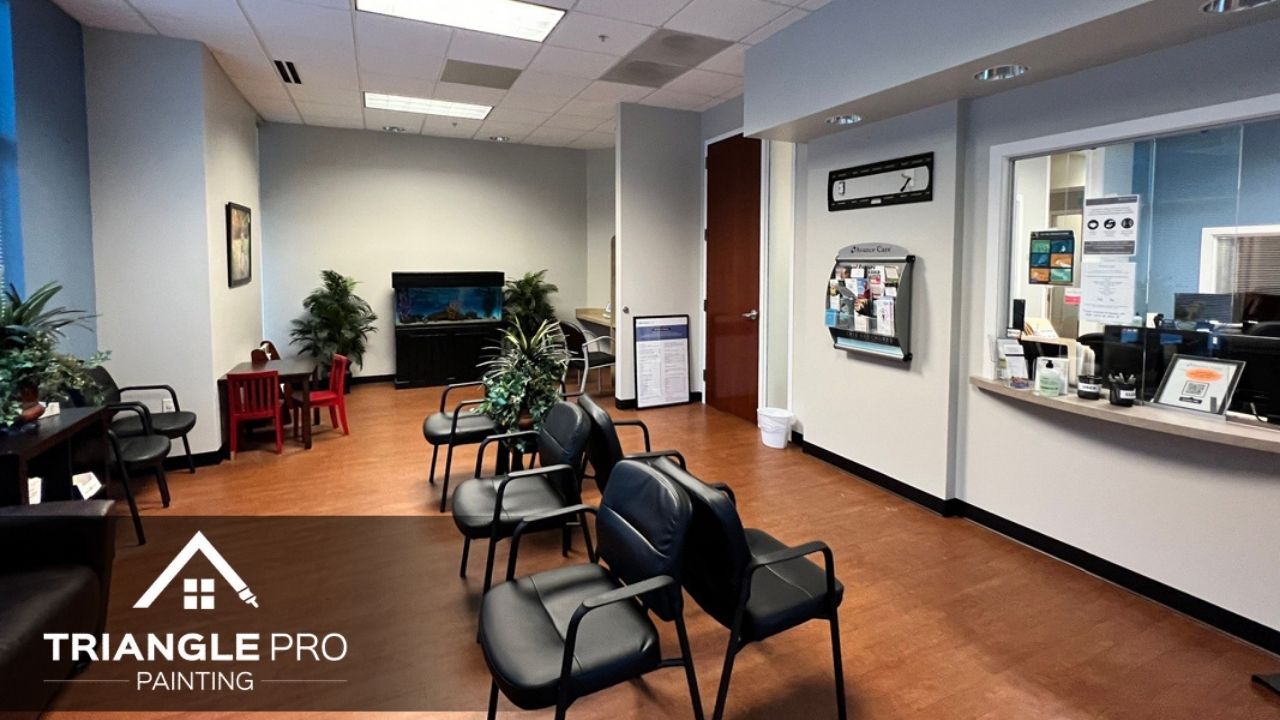
Real Office Painting Cost Examples
Actual project costs reveal how square footage, labor hours, and materials combine into final invoices. These examples reflect completed Raleigh office projects with standard wall conditions and two-coat application.
Standard Office Suite Pricing
An 800 square foot office suite with four walls measuring 20 feet in length and 10 feet high requires eight total hours of labor for complete coverage. At the upper labor rate of $65 per hour, this project costs $520 in labor alone. Materials and supplies add approximately $344, bringing the total project cost to $864 for walls in good condition requiring minimal repair.
A 2,400 square foot facility represents a more common commercial space size. Labor requirements increase to 24–27 hours, costing between $1,320 and $1,755. Paint and supplies for this size space total $880 to $1,200, depending on paint quality selection.
The complete project ranges from $2,200 to $2,760 when surfaces don’t require extensive cleaning or damage repair.
Conference Room and Common Areas
Conference rooms typically fall into the smaller square footage category but present unique challenges. A 600 square foot conference room costs approximately $650 to $750 when factoring in the detailed work around built-in features.
Whiteboards, projection screens, and wood paneling require careful masking, adding 1–2 hours beyond standard prep time.
Reception areas and hallways average $1.08 per square foot, identically to private offices. A 1,200 square foot reception and common area combination totals roughly $1,296 for complete coverage.
Multi-Floor Office Buildings
Large-scale projects spanning multiple floors achieve efficiency through crew deployment across simultaneous work zones.
A 6,000 square foot office distributed across two floors requires approximately 60 hours of painting labor, totaling $3,300 to $3,900. Materials for this project scale to $1,560 to $2,400, bringing complete project costs to $4,860 to $6,300.
Equipment transportation between floors and extended project coordination add 5–10% to base estimates.
How to Get an Accurate Painting Quote
Requesting quotes from multiple contractors reveals price variations, but the inspection process determines accuracy. Professional painters follow systematic evaluation methods that translate your office conditions into precise cost projections.
What Professional Contractors Inspect
Thorough property inspections form the foundation of accurate estimates. Contractors measure total square footage, calculating length multiplied by height for walls while subtracting windows and non-paintable surfaces.
They examine wall conditions to identify damage beyond standard prep work, as drywall replacement or extensive repairs fall outside typical preparation costs.
Surface type assessment determines material requirements. Textured walls absorb more paint than smooth surfaces, increasing both material quantities and application time.
Questions to Ask During Estimates
Ask specifically whether the quote includes ceiling painting or only walls. Confirm if trim will receive different colors than walls, as this detailed work adds time.
Request clarification on furniture relocation, since moving equipment to access surfaces increases labor costs.
Inquire about the number of coats included in the estimate. Dramatic color changes from dark to light shades may require additional coats or primer beyond the standard two-coat application.
Understanding Your Itemized Quote
Professional contractors provide itemized breakdowns separating labor, materials, and supplies. Labor costs at $55 to $65 per hour should list estimated hours for painting and prep work separately.
Material costs should specify paint quality, quantity in gallons, and per-square-foot pricing ranging from 26 to 40 cents for two coats.
The itemized format reveals where your money goes and helps you compare competing bids fairly. Getting at least three estimates from different Raleigh contractors provides perspective on fair market pricing for your specific office conditions.
Conclusion
Commercial interior painting costs in Raleigh depend on far more than just square footage. Wall condition, paint quality, ceiling height, accessibility, and project scheduling all influence the final investment. Understanding these factors helps office and retail owners avoid unrealistic low bids and budget confidently for a professional result that lasts.
Although it may be tempting to choose the cheapest proposal, long-term value comes from proper preparation, durable materials, and experienced commercial painters who understand how to work efficiently in active business environments. A professionally completed commercial paint project improves your property’s appearance, strengthens your brand image, and creates a cleaner, more professional experience for employees and customers alike.
Whether you’re refreshing a small office suite, updating a retail storefront, or repainting an entire multi-floor commercial building, working with an experienced local contractor ensures the project stays organized, efficient, and completed to a high standard. From detailed estimates and scheduling flexibility to premium coatings and precise workmanship, Triangle Pro Painting helps Raleigh business owners protect their investment while achieving polished, long-lasting results.